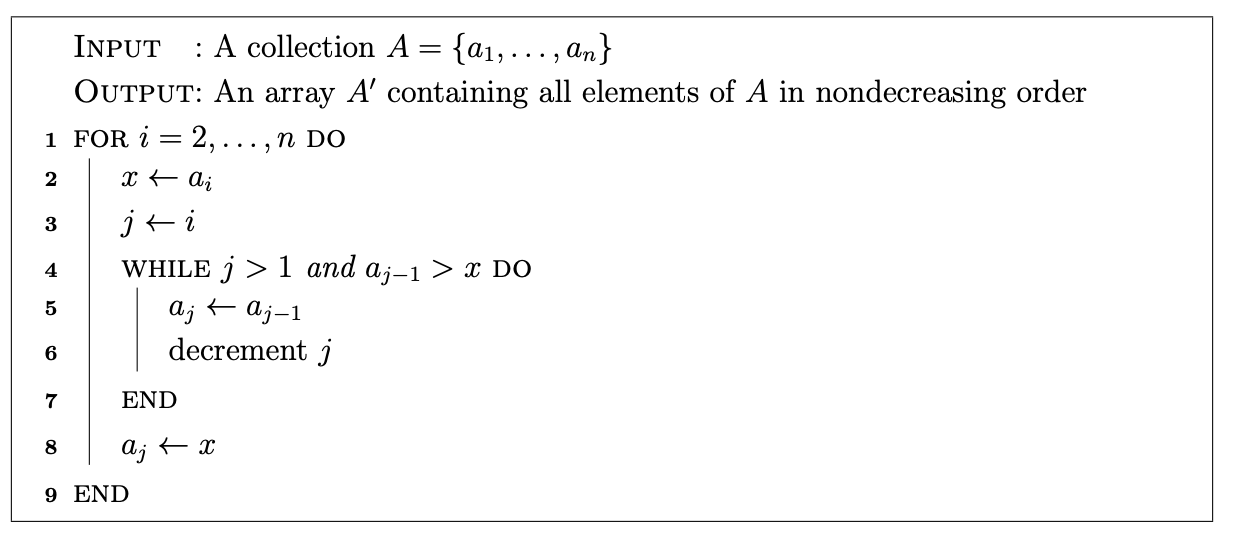
• Best case: list is already sorted, number of comparisons is $(n − 1)$ • Worst case: reversed list; each iteration shifts the element all the way down • First iteration: 1 comparison, 2nd: at most 2, etc., last iteration: at most $(n − 1)$ comparisons $$\sum_{i=1}^{n-1}i=\frac{n(n-1)}{2} $$ • Worst case: $O(n^2)$ • A more complex analysis for the average case, but still $O(n^2)$ • Practical consideration: insertion sort is inherently adaptive; good performance in practice • Very efficient on small lists, especially if there is already some structure (partially ordered) to them
Code Samples
Code Sample 13: Java Insertion Sort for integers
1
2
3
4
5
6
7
8
9
10
11
12
publicstaticvoidinsertionSort(int array []) { int value ; for (inti=1; i < array . length ; i ++) { value = array [ i ]; intj= i ; while ( j > 0 && array [j -1] > value ) { array [ j ] = array [j -1]; j - -; } array [ j ] = value ; } }
Code Sample 14: C Insertion Sort for integers
1
2
3
4
5
6
7
8
9
10
11
12
voidinsertionSort(int * array , int size ) { int value ; for (int i =1; i < size ; i ++) { value = array [ i ]; int j = i ; while ( j > 0 && array [j -1] > value ) { array [ j ] = array [j -1]; j - -; } array [ j ] = value ; } }
The function mergeSort would be called as follows:
1
2
3
int * a = (int *) malloc ( sizeof (int) * n ) ;
...
mergeSort (a , 0 , n -1) ;
voidmerge(int * array , int left , int mid , int right ) { /* temporary array to store the new sorted part */ int tempArray [ right - left +1]; int pos =, lpos = left , rpos = mid + 1; // not strict ANSI C while ( lpos <= mid && rpos <= right ) { if( array [ lpos ] < array [ rpos ]) { tempArray [ pos ++] = array [ lpos ++]; } else { tempArray [ pos ++] = array [ rpos ++]; } } while ( lpos <= mid ) tempArray [ pos ++] = array [ lpos ++]; while ( rpos <= right ) tempArray [ pos ++] = array [ rpos ++]; int iter ; /* copy back the sorted array to the original array */ for ( iter =0; iter < pos ; iter ++) { array [ iter + left ] = tempArray [ iter ]; } return ; }